myAGV Plus
1. Product Overview
1.1 Product Introduction
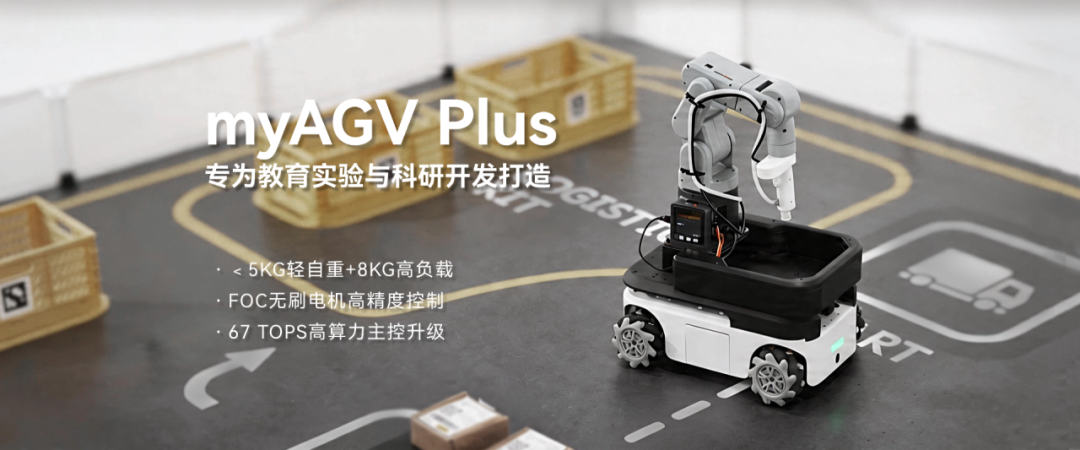
myAGV Plus is a full upgrade of myAGV Jetson Nano 2023. The chassis is equipped with the NVIDIA Jetson Orin Nano Super processor, designed to meet high-performance computing needs in scenarios such as image vision processing and AI algorithm deployment. It uses competition-grade Mecanum wheels with a fully enclosed metal frame, balancing mobility and structural durability. Built on the ROS2 development platform, it comes with three mainstream SLAM algorithms to fully support user learning and development in mapping and navigation. It also offers a variety of extension interfaces, supporting my series robotic arms, making it easy to achieve mobile picking and other complex functions, helping users expand into more application scenarios.
1.2 Design Concept
The launch of myAGV Plus aims to meet the core needs of users for higher performance, stronger computing power, and a more modern development environment in educational research, business exhibitions, and personal learning scenarios. Building on myAGV 2023, it offers comprehensive hardware and software upgrades to create a platform that maintains the ease of use and open-source advantages of the first-generation product while supporting more complex, advanced robotics projects. The main design goal of this upgrade is to retain full-stack development interfaces like Python API, myStudio, and myBlockly, ensuring usability and continuity in educational settings, while upgrading the main controller from Jetson Nano B01 4GB to Jetson Orin Nano Super 8GB. Computing power jumps from 0.5 TFLOPS to 67 TOPS, providing ample support for AI tasks like 3D mapping navigation and complex vision algorithms. The motors are upgraded to FOC planetary brushless DC motors, increasing maximum load from 5KG to 8KG and mobility speed from 0.9m/s to 1.6m/s, significantly boosting platform movement performance and load capacity. It fully supports the Ubuntu 22.04 ROS 2 stable ecosystem, moving away from the limitations of customised Ubuntu 20.04 versions, allowing developers to use the latest open-source toolchains and third-party libraries directly. Ultimately, it covers all scenarios from beginner teaching to advanced research, from basic exhibitions to complex applications, providing users at different stages with a more powerful, higher ceiling, and better experience robotics development platform.
1.3 Design Goals
| Design goal | Description | Use cases and features |
|---|---|---|
| Meet the computing power needs for high-performance mobile robot development | Equipped with the NVIDIA Jetson Orin Nano Super 8GB processor, delivering up to 67 TOPS, paired with competition-grade Mecanum wheels and FOC brushless planetary motors, it can handle a maximum load of 8KG and move at a top speed of 1.6m/s. It natively supports Ubuntu22.04 ROS2 Humble, comes with multiple popular SLAM algorithms, and supports high-precision autonomous mapping and navigation. | - University research scenarios: Sufficient computing power allows smooth operation of complex algorithms like 3D SLAM, visual recognition, and AI large model deployment, supporting cutting-edge research topics such as mobile robot navigation, visual grasping, and multi-agent collaboration; - Automation verification scenarios: High-load, high-speed mobile platforms can carry robotic arms to complete combined tasks like mobile picking and material transfer, used for simulating and verifying small production line automation solutions |
| Lower the barrier for developing and teaching mobile robots | Fully continuing the my series mature open-source ecosystem, comes pre-installed with myStudio, myBlockly drag-and-drop programming tools and a full set of Python APIs, compatible with graphical, scripting and ROS2 multi-level development; provides standardised expansion interfaces, ready to use out of the box without complex environment compilation, allowing beginners to get started quickly. | - Educational settings: It supports both graphical drag-and-drop programming and professional ROS2 development environments, suitable for general robotics education in primary and secondary schools as well as practical training in university robotics courses, making it easier to get started with robot programming; - Enterprise research settings: You don't need to build the underlying drivers and navigation framework from scratch, allowing technical staff to quickly develop mobile robot prototypes, shorten the research cycle and reduce R&D costs. |
| Expanding the innovative applications of composite robots | Natively compatible with the my series robotic arms, can be combined to achieve integrated mobile grasping; rich hardware expansion interfaces support external devices like depth cameras, LiDAR, voice modules, etc., with fully open ROS2 source code on the software side, supporting secondary deep development and adaptable for multimodal intelligent interaction development. | - Sci-tech competition scenario: The chassis and robotic arm composite structure can complete tasks like autonomous line tracking, target grabbing, and intelligent sorting, suitable for various robot innovation competitions; - Commercial display scenario: With high-speed autonomous navigation, visual recognition, and voice interaction capabilities, it can create smart guide and interactive display robots to enhance exhibition and store interaction experiences; - Personal development scenario: Complete open-source hardware and software materials are provided, allowing enthusiasts to independently develop personalised mobile robot projects for inspection, following, delivery, etc. |
2. Product Applications
2.1 User Groups
| user group | Use case | Goals and benefits |
|---|---|---|
| Teachers and students in education | - STEM education - Robotics projects - Interdisciplinary research projects |
- Spark students' interest in technology - Boost hands-on and problem-solving skills - Encourage creative thinking and teamwork |
| researcher | - Prototype development - Experimental research - Algorithm testing and validation |
- Speed up research progress - Link theory with practice - Push forward tech innovation |
| Business presentation and marketing pros | - Exhibitions and displays - Tech demos - Brand promotion |
- Attract potential customers and investors - Showcase the company's technical strength and innovative products - Boost brand influence |
| Personal hobbyists and self-learners | - Learning programming - Exploring robotics - Basics of AI |
- Improve personal skills and knowledge - Achieve self-education and development - Explore the potential of robotics and artificial intelligence |
3.Support for Extended Development
myAGV Plus encourages users to get involved in extended development to fully unlock its potential:
- Programming Languages: Supports Python, ROS2, and more, offering a variety of programming options.
- Hardware Interfaces: Includes IO, USB, and more, making it easy to connect various sensors and actuators.
- Software Libraries: Offers a wealth of open-source libraries and APIs to simplify the development process.
Purchase Link
If you're interested in buying this device, please click the link below.
- Taobao: https://shop504055678.taobao.com
- shopify: https://shop.elephantrobotics.com/
Thank you for reading
Thanks so much for taking the time to read the myAGV Plus user manual. We hope this manual helps you better understand and make effective use of this robot, sparking your creativity. If you have any questions or need further assistance, feel free to reach out to our customer support team. We can't wait to see the innovative projects you create with myAGV Plus and welcome you to join our fast-growing developer community.